

11 Nov Pharyngeal carcinoma: Why early diagnosis is crucial
Changes in the throat often go unnoticed for a long time. Because early signs are often absent or unspecific, a tumour in this area is often only discovered late. However, it is precisely the time of diagnosis that determines the chances of recovery. Modern ENT diagnostics can help to recognise abnormalities early and treat them in good time.
About the throat
The throat - known medically as the pharynx - is a muscular tube that connects the nose, mouth and larynx. It extends from the base of the skull to the beginning of the oesophagus. Depending on its location, the pharynx is divided into three sections: Nasopharynx (nasopharynx), oropharynx (oropharynx) and hypopharynx (hypopharynx). Its main functions include
- Enable breathing
The pharynx directs the inhaled air from the nose or mouth into the larynx and from there into the windpipe. This makes it an important part of the upper respiratory tract. - Control the food path
When swallowing, a complex muscle movement ensures that food and liquids enter the oesophagus while the airways remain closed at the same time. This is how the pharynx protects against "swallowing". - Support speech
Together with the oral and nasal cavities, the pharynx serves as a resonance chamber. It influences the sound, volume and intelligibility of the voice. - Assume defence functions
Lymphatic structures such as the palatine and pharyngeal tonsils are located in the mucous membrane of the throat. They form an important part of the body's immune system and help to fight off pathogens.
The pharynx therefore fulfils several vital tasks.
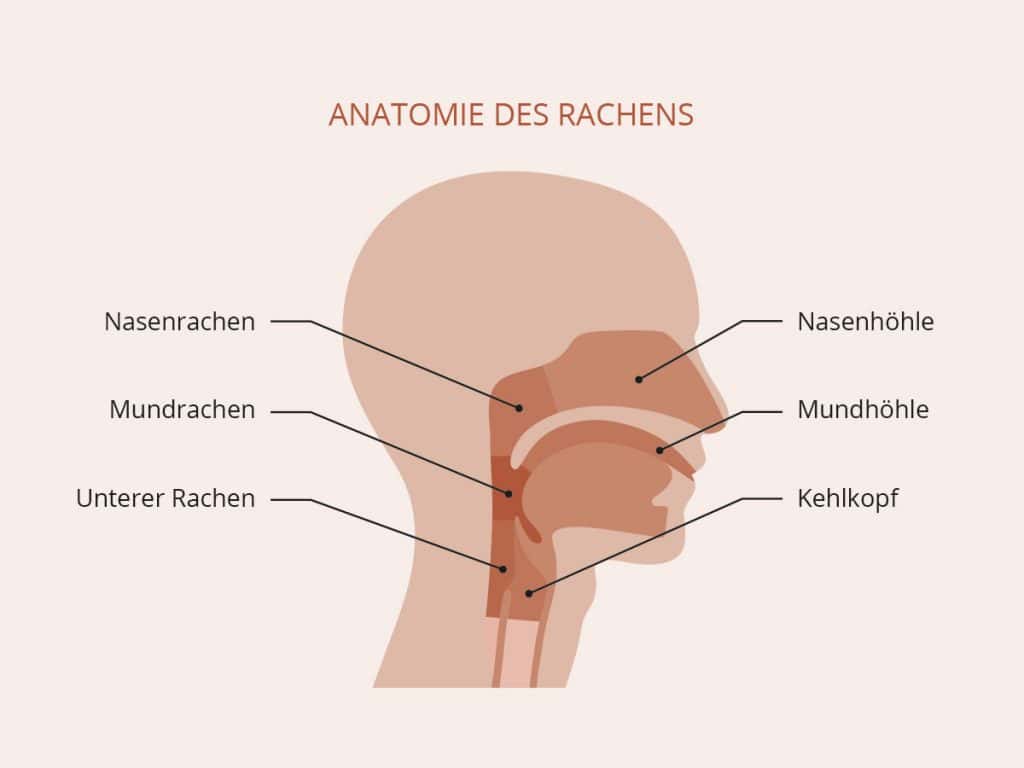
Pharyngeal carcinoma: malignant tumour in the pharynx
Pharyngeal carcinoma is a malignant tumour that develops in the mucous membranes of the throat (pharynx).
There are three main forms, depending on the site of origin: nasopharyngeal carcinoma (nasopharyngeal carcinoma) in the upper section behind the nasal cavity, oropharyngeal carcinoma (oropharyngeal carcinoma) in the area of the palate, base of the tongue and tonsils, and hypopharyngeal carcinoma (hypopharyngeal carcinoma) near the junction with the oesophagus.
The disease belongs to the group of head and neck tumours and usually originates from the cells of the mucous membrane, which multiply uncontrollably and displace healthy tissue.
The most important risk factors are long-term tobacco and alcohol consumption. Infections with certain types of the human papillomavirus (HPV) or chronic irritation of the mucous membrane can also favour the development of the disease.
Pharyngeal carcinoma symptoms: If you have these symptoms, you should definitely have yourself examined
The symptoms of pharyngeal carcinoma depend greatly on the section of the throat in which the tumour develops and how advanced the disease is. Initially, the signs often remain unspecific and are easily overlooked. However, if a change in the throat or pharynx persists over a longer period of time or recurs, you should have it checked out by a doctor. We can differentiate between possible causes and - if necessary - treat them at an early stage.
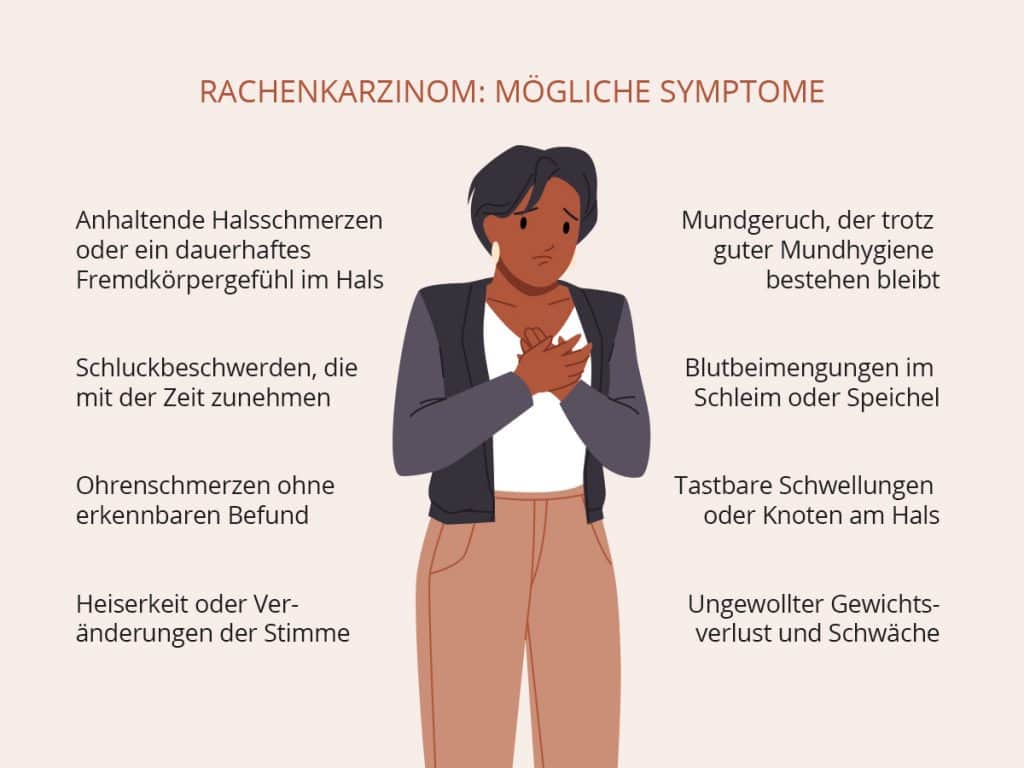
The symptoms that can occur with a tumour in the throat area include
Persistent sore throat or a persistent foreign body sensation in the throat
At the beginning, some sufferers experience a slight scratching or pressure sensation in the throat, which becomes stronger or more constant over time. It is typical to feel as if a small lump or foreign object is lodged in the throat, even though nothing is visible there. The discomfort can occur on one side and sometimes radiates into the ear.
Unlike a common sore throat, the pain does not subside after a few days, but persists for weeks. Medication, gargle solutions or household remedies do not bring any improvement in this case. This persistent discomfort arises because the tumour irritates the surrounding tissue and exerts pressure on the nerves or mucous membrane.
Difficulty swallowing that increases over time
At the beginning, swallowing is often only occasionally difficult, e.g. if the food is very firm/chewy or with larger bites. Over time, the discomfort increases and even swallowing soft foods or liquids can be uncomfortable or painful.
The cause is that a growing tissue change in the throat impedes the swallowing process or exerts pressure on the surrounding nerves. Some sufferers avoid eating as a result, which can lead to weight loss and exhaustion.
Earache without recognisable findings in the ear
Sometimes Earache although the ear itself is inconspicuous. This is because the pharynx and middle ear are connected via the eustachian tube. Irritations or tumours in the throat can transmit pain signals to the ear via shared nerve pathways.
Those affected then feel a dull aching or stinging sensation, usually only on one side. As no inflammation or injury can be seen on examination of the ear, the actual cause often remains hidden at first. If such unilateral ear pain occurs over a longer period of time without any clear findings, you should also have the throat area checked carefully.
Hoarseness or changes in the voice
If the sound of the voice changes permanently, this may be an indication of a change in the pharynx or throat. Larynx area be. If the tumour is close to the vocal folds or spreads to the larynx, this disrupts the vibrations of the vocal folds. Vocal cords. The voice then sounds raspy, brittle or overheated and loses power.
Some patients also report that they become hoarse more quickly or that their voice fails after a short period of exertion. Unlike a cold or laryngitis, hoarseness does not improve after a few days, but persists or gradually worsens.
Bad breath that persists despite good oral hygiene
An unusually strong or foul odour from the mouth can occur when pathologically altered tissue forms in the throat. In such cases, even thorough tooth brushing or mouthwashes are of little help.
The cause is not in the mouth, but deeper down - where the tumour is located. Small bleedings, dead cells or bacterial decomposition processes in the tumour tissue produce odours that are perceptible when breathing or speaking.
A medical examination can clarify whether the symptom is a harmless inflammation or a more serious change.
Blood in the mucus or saliva
Some sufferers notice that the sputum contains small traces of blood when coughing. This occurs when the mucous membrane in the throat is irritated or injured by the tissue change and fine blood vessels break open. The blood then mixes with saliva or mucus and becomes visible when spitting out.
palpable swellings or lumps on the neck
Throat cancer can also be characterised by swelling in the neck. This often occurs when lymph nodes enlarge - either as a reaction of the immune system or because tumour cells have settled there.
The lumps usually feel firm, are difficult to move and generally cause no pain.
Unintentional weight loss and general weakness
If a tumour in the throat persists for a long time, it can put a noticeable strain on the entire body. Many sufferers lose weight without consciously changing their diet. One reason for this is that swallowing becomes increasingly difficult and food intake is restricted.
On the other hand, the body itself consumes more energy due to the tumour disease, while the appetite can decrease at the same time. Persistent tiredness or weakness can also set in.
Detecting throat cancer: How is throat cancer diagnosed?
Comprehensive diagnostics at our ENT clinic in Frankfurt help to recognise and treat throat cancer at an early stage. The first step begins with a detailed discussion about symptoms, their duration and possible risk factors such as smoking or alcohol consumption. We then examine your mouth and throat with the help of a small mirror and a flexible Endoscope camerawhich also makes deeper areas visible.
If we notice any changes to the mucous membrane or lumps, a tissue sample (biopsy) is usually taken. Only a histological examination in the laboratory can show with certainty whether it is a malignant change.
Imaging procedures such as CT or MRI can also be used. They help to determine the exact extent of the tumour and identify possible lymph node or organ involvement (metastases). This provides a complete picture of the disease, which serves as the basis for further treatment planning.
Treating throat cancer: How is pharyngeal carcinoma treated?
The treatment of a throat carcinoma depends on the exact location of the tumour, its degree of spread and your general state of health. The earlier we recognise the disease, the greater the chances of successful treatment. Various forms of treatment are available, which can be used individually or in combination. The basic options are
Operation
Surgery is one of the most important forms of treatment for a malignant tumour in the throat, especially if it is still localised. The aim is to completely remove the malignant tissue while preserving as much healthy tissue as possible. Different surgical procedures are used depending on the location of the tumour.
Smaller tumours can often be removed in a minimally invasive way, e.g. using an endoscope or a laser. These gentle techniques enable precise tumour removal through the mouth without the need for large external incisions. In the case of more advanced findings, however, an open surgical approach may be necessary so that the tumour tissue can be completely removed.
In some cases, neighbouring lymph nodes in the neck area are also removed during the procedure to rule out possible metastases.
Radiotherapy (radiotherapy)
Radiotherapy is a key treatment option for throat cancer and can be used as a stand-alone therapy or in combination with surgery or chemotherapy. Its aim is to destroy cancer cells while sparing the surrounding healthy tissue.
Modern radiotherapy methods - such as intensity-modulated radiotherapy (IMRT) - allow the radiation dose to be controlled with pinpoint accuracy. This allows the radiation to be concentrated precisely on the tumour area. Sensitive structures such as the salivary glands, spinal cord or larynx remain largely protected.
In early tumour stages, radiotherapy can often completely eliminate the cancer and make surgery unnecessary. In more advanced cases, it is used to destroy remaining tumour cells after an operation or to slow down tumour growth.
Temporary side effects may occur during treatment - for example, difficulty swallowing, irritation of the mucous membrane or temporary loss of taste. Careful accompanying therapy and regular aftercare help to alleviate these symptoms and support the healing process.
Chemotherapy
Chemotherapy is often used to treat throat cancer in addition to radiotherapy or surgery. It uses special drugs (known as cytostatics) that inhibit the growth and division of cancer cells or kill them completely. As tumour cells divide faster than healthy cells, they are particularly sensitive to these drugs.
As a rule, chemotherapy is used as an accompanying treatment to radiotherapy (radiochemotherapy), for example. This combination allows the two procedures to reinforce each other: the radiation directly destroys the tumour tissue, while the medication makes the cancer cells more sensitive to the radiation. This significantly increases the effectiveness of the therapy.
In the case of advanced or metastatic tumours, chemotherapy also serves to slow tumour growth, alleviate symptoms and maintain quality of life.
Typical side effects such as nausea, tiredness, irritation of the mucous membranes or hair loss occur because healthy cells can also be affected for a short time.
The therapy is always customised and closely monitored in order to keep the burden as low as possible.
Immunotherapy / targeted therapies
These concepts are becoming increasingly important in the fight against throat cancer. They are directed against certain properties of cancer cells or activate the body's own defence system. This can often fight the tumour cells particularly effectively.
So-called checkpoint inhibitors are used in immunotherapy. These drugs block signalling pathways that cancer cells use to "switch off" the immune system. If this blockade is removed, the body's own defence cells can recognise and attack the tumour cells again. Immunotherapy is primarily used for advanced or recurring tumours when other treatments have been exhausted or are not sufficiently effective.
Targeted therapies work differently: they attack specific structures or growth mechanisms of the cancer cells, e.g. certain receptors on their surface. A well-known example is the use of antibodies against the so-called EGFR (Epidermal Growth Factor Receptor), which is overactive in many head and neck tumours.
Both forms of therapy are considered important advances because they are even more precise and largely spare healthy cells. Regular check-ups and careful medical supervision are crucial in order to optimally control the effect and possible side effects.
Nutritional, swallowing and speech therapy
Functional rehabilitation plays a crucial role following treatment for throat cancer - especially after surgery or radiotherapy and chemotherapy. The aim is to gradually restore natural abilities such as swallowing, speaking and adequate food intake.
Swallowing therapy helps you to train the muscles in the throat and pharynx area. Through special exercises, you will learn to safely coordinate movements when eating and drinking and reduce the risk of choking.
Speech therapy (speech therapy) helps to compensate for changes in the voice or articulation. This allows you to regain your vocal resilience and intelligibility when speaking. This is an important step towards being able to communicate actively again in everyday life.
If swallowing is still restricted or there is weight loss, additional nutritional counselling may be useful. Specialists will show you how a balanced, well-tolerated diet can support your recovery and provide you with new energy.
These rehabilitative measures make a significant contribution to maintaining your quality of life after cancer treatment and gradually returning to your normal everyday life.
Early detection saves lives: Why ENT cancer screening at our practice in Frankfurt is so important
Diseases such as throat, larynx or oral cavity cancer are often inconspicuous in the early stages. However, the earlier a cancer is detected, the better the chances of recovery - often even with significantly milder treatment methods. Regular Cancer screening in the ear, nose and throat area makes a decisive contribution to recognising potential changes in good time. In our ENT clinic in Frankfurt we carry out thorough analyses in order to identify risks at an early stage and to be able to react immediately if necessary.
For whom is ENT cancer screening particularly important?
Certain risk factors increase the likelihood of developing throat cancer. If you are one of them, you should regularly Control examination perceive:
- Smoking
Tobacco consumption is considered one of the most significant risk factors for tumours in the throat and pharynx. - Frequent alcohol consumption
Alcohol irritates the mucous membranes and can also increase the effect of tobacco. - HPV infections
Some types of human papillomavirus are closely associated with head and neck tumours. - Occupational stress
Contact with certain chemicals, solvents or fine dust can increase the risk.
Make an appointment for ENT cancer screening now
A screening examination only takes a few minutes, but can make a decisive contribution to the early detection of cancer. Feel free to make an appointment at our ENT clinic in Frankfurt - for your safety and health.
Do you have any questions on this topic or would you like to arrange a consultation?
ENT Frankfurt: Dr Thomas Fischer & Dr Albrecht Linke
Your specialists for ear, nose and throat medicine, who will provide you with professional and individualised advice, examinations and treatment in all matters relating to ENT medicine, functional plastic surgery and the aesthetic treatment of changes to the facial skin.
Our news articles are prepared for you to the best of our knowledge and belief and are intended for general education. They are in no way a substitute for medical advice, diagnosis and treatment and are not intended to encourage self-diagnosis or self-treatment. Please always contact your ENT specialist in Frankfurt directly if you have any health complaints!
© "Young woman pulping her inflamed neck" by sebra, stock.adobe.com
© "Throat anatomy poster " by pikovit, stock.adobe.com
© "Chest pain in young woman vector illustration. Cartoon isolated sick girl suffering from symptoms of cardiovascular disease or breasts problem, palpitations and heart attack, fibromyalgia and stress" by Natalia, stock.adobe.com

 English
  German
  Arabic